Thursday, March 7, 2013

Songs for Us Seniors


I find it very interesting that pop music has afforded us seniors with two songs perfect for this time of transition into the “real world”. Both “Thrift Shop” and “Suit and Tie” are extremely applicable to and fit us well.
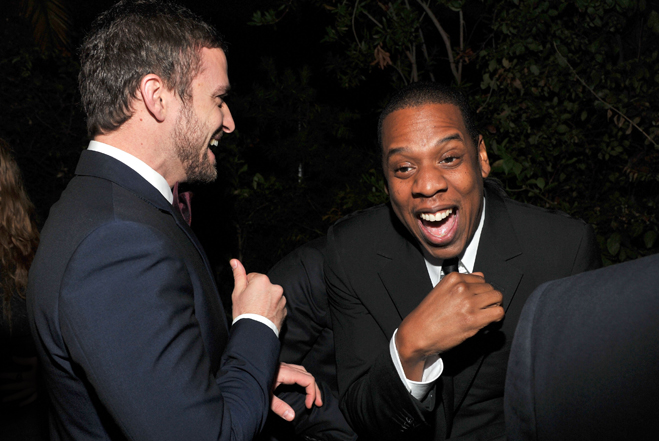
Justin Timberlake and Jay-Z
Macklemore’s indie-rap jam details an action that a lot of seniors already enjoy to do: buy clothes secondhand. And as the song catalogues, there is a certain fashion statement to be made by wearing these clothes. Specifically, a second hand “long ass coat” suggests that the wearer does not care about materialistic standards and will wear something simply because it keeps them warm. It also speaks to the reality that a lot of us seniors are going to be facing: we may not have “fifty dollars for a t-shirt” and we will gladly wear some goodwill garments. At least we have an anthem for this style.
JT’s comeback collaboration with Jay-Z shows the other side of being a senior: we suddenly have to look presentable at any and all times because of job interviews. For those of us entering the work force, having a suit and tie stashed away in our closets is one thing we can have stacked in our favor as we attempt to gain some form of employment. The chorus from the song “as long as I’ve my suit and tie” can become a mantra quietly chanted as we sit in waiting rooms in anticipation of our names being called. Plus, for nostalgic value it is nice to have Justin Timberlake contributing to the soundtrack of our senior spring. I am sure for many he did the same for elementary school graduations.
Senior Spring can be tough and daunting at times, so it makes me smile in delight that pop music has provided us with two songs that are so perfectly timed to keep us dancing and partying in this final semester. I only hope that as I experience more milestones in life, new music can once again synch up with what is going on in my life. If so, I will be reminded of the magic felt this semester. 

Nick Howard '13
Image credit: Philly.com

Friday, February 1, 2013

Who does fake news better?


If you frequent Rolling Stone’s web site as often as I do, than you are well acquainted with their infamous top 50 lists, top 50 guitarists, top 50 hip hop songs etc. Their most recent list published was “The 50 Funniest People Now”, full of today’s greatest comedic minds such as Chris Rock, Louis C.K., and Tina Fey. The list seemed well thought out and assembled, until I reached the top 5. Both Jon Stewart and Stephen Colbert had placed in the top 5, but Colbert at number 2 and Stewart at number 4. I have to be honest, for a moment I was speechless.

Jon Stewart has been on the air since I was 6 years old and Colbert since I started junior high school. Since I was old enough to, I have always had an appreciation for comedy and politics, so you can imagine why these programs have been stalwart favorites of mine for so long. I have spent many a night watching these shows back to back, laughing until I cry over the years and yet also noticing the subtle changes and adjustments that each show has undergone, Stewart constantly making new stars in the comedy world through the famous “correspondent” role on his show, and Colbert giving the world renowned “Colbert Bump” to any who he sees fit. Before high school, I became obsessed with The Colbert Report, watching it every night at 11:30 in my bedroom before I fell asleep. At the time, I tried to watch The Daily Show too, but it just couldn’t hold my attention. I loved Colbert because he was the epitome of hyperbole, never breaking his ridiculous and unyielding conservative character he had modeled after Bill O’Reilly. His jokes mocking our beloved political system were pure sarcasm, and made me laugh uncontrollably. And yet, by the time I reached high school me and Stephen had lost touch, and suddenly a new funny man came to fill the comedic void in my heart: Jon Stewart.

As I got older, I came to appreciate Stewart for all the reasons I had hated him before. As I matured, I became more interested in the real news that Stewart was covering in a satirical manner, than the utterly ridiculous antics of Colbert which were getting a bit old to me as the years went on. Since then, I have remained a fan of both shows, but I live for my 30 minute lunch break between classes from Tuesday to Thursday when I can watch the episode of The Daily Show from the night prior.

Returning to the Rolling Stone list, I feel that a mistake was made placing Colbert above Stewart for multiple reasons. The first being that there would be no Stephen Colbert without Jon Stewart! Colbert was originally a correspondent on The Daily Show, and through his on air antics with Stewart became far better known than his multiple appearances on Whose Line Is It Anyway. Stewart provided a platform for Colbert to display his comedic genius, one that Stewart essentially helped create. I also believed Stewart to be funnier because he doesn’t put on the same show every single night. Each night Stewart covers a different kind of story with a different comedic approach, be it in a gut splitting dialogue with Larry Wilmore or John Hodgman, or a video compilation narrated by Stewart’s classic rants. While Colbert seems to go through the same routine each night, receiving a standing ovation as the show begins, ranting in character for two segments sometime outright or through segments like “The Word”, and then interviewing someone also while in character. I feel that Stewart deserves recognition as the better comedian because he can make both the ridiculous and delicate news topics humorous, and therefore easier to discuss.  Colbert’s constant sarcasm and hyperbole, his ridiculousness for a lack of a better word, can be annoying at times and requires far less creativity than Stewart’s method of comedy. Stewart’s varied approach to both the ridiculous and the delicate news story give him a comedic edge over Colbert, which should have placed him higher on the list above his protégé.

Despite my ramblings, I am still avid member of Colbert Nation and will no doubt be forcing my roommate to watch both programs with me tonight, laughing in a manner that can only be induced by the ingenious comedy of the two most famous fake newsmen in the world.


Brendan Monahan '15
Image credit: Pulse2

Tuesday, January 22, 2013

Popular Folk Rock: A Breath of Fresh Air to the Music Industry


The day after Christmas, my brother and I went to see The Roots at the House of Blues in Boston. We were lucky to catch them on a short touring stint as they took some time off from The Jimmy Fallon Show, seeing them was like a blast from the past. The last time I had seen them perform was at least 3 or 4 years ago. But anyways, per the usual The Incredible Roots Crew was, well...incredible. As my brother and I left the show and headed to the parking garage near Gold’s Gym where we had parked, he popped in the new Lumineers CD and “Ho-Hey” came on. Which got me to thinking: is folk rock making a comeback on the popular music scene?

Now let me first say, that I understand that the concept of folk rock is one that is very fluid and that differs between listeners. But when I think folk rock, I think Bob Dylan, acoustic Paul Simon, Neil Young, some of CSNY or James Taylor’s work. Most of this music has faded into the past, still being listened to by children of the 1960’s and 70’s, or even some of us in college now. Nonetheless, the last decade of popular music has been dominated by artists such as Ke$ha, Flo Rida, Pit Bull, and the list goes on. And yet, in the last 3 years we have seen a re-emergence of the more traditional sense of artists and musicians onto the popular music scene beginning in 2010 with the release of Mumford & Sons’ first album in the U.S., “Sigh No More”. All of a sudden, these foreign folk rockers were flooding American radio waves with amazing tunes like “Little Lion Man” and “Timshel”. To me, this marked a turning point, as what I perceived as “real music” (no offense to other popular artists, or their fans) was becoming popular. I could turn on a popular radio station, and actually hear a song or two that I enjoyed.

I think we have come to another impasse fairly recently, as the Lumineers’ new hit single mentioned above becomes more popular by the day, with I am sure many more to follow. It is hard to put my thumb on it, but pop music is undergoing some sort of progression or transformation, one in which we are getting back in touch with our musical roots. This may either be a passing fad, or perhaps a new era or popular music, either way I plan to enjoy it while it lasts. I will begin by returning to the House of Blues on February 4th to see the Lumineers bring down the house, bass drum, banjo and all.
 
Brendan Monahan '15
 
Image credit: Just Jared


Wednesday, December 12, 2012

That Gnawing Thought: Zombies in Popular Culture


Looking at bestselling books and popular movies, a person might conclude that vampires are in style. But amongst the ranks of the undead, vampires are miles behind another group of ghouls when it comes to overall cultural significance. From video games like Left 4 Dead to the television series The Walking Dead, zombies are on the rise out of the grave and into public consciousness. Interest in these shambling horrors has spiked in recent years and only continues to grow. As I write this, I can glance and spy a book I plan on reading over winter break on my shelf: Theories of International Politics and Zombies, written by Professor Daniel W. Drezner. Disbelief at my own dorkiness aside, the truth of the matter should shock you. Zombies have even penetrated academia.
"Braiinnnnsssss...."
Why such a fascination with zombies? What sets them apart from the witches, vampires, ghosts, and demons? I have a few suggestions. Scientists argue that there is at least the possibility of zombies existing. Similar occurrences are no stranger to biologists; take the fungus Ophiocordyceps unilateralis, for example. That is the main difference between zombies and the rest: they are plausible. There is nothing magical about them. They could exist. Remember the story on the news this of the cannibal who devoured the face of a homeless man? More than a few people grew nervous about the possibility that this was some type of zombie. Even when the police announced it was bath salts that caused the man to act in such a way, it does not erase that fact that our minds jumped to the possibility of a zombies.
Zombies are also unlike other creatures in the effects that produce on a society. Recent depictions of vampires, for example, show them coexisting in the world with regular people. They merge with our own institutions or create new ones, sometimes threatening that of humans, but the world continues onward. Zombies change everything. There is little chance of coexistence; humanity either survives or dies. Typical social structures disappear completely in an outbreak. It is a crisis that alters the world in a horrifying and irreversible way.
I believe this is the crux of the matter. Zombies are considered fictional, but the disaster they could create is very real. In entertaining the idea of a zombie apocalypse, it raises questions about how prepared the world is for other catastrophes. A pandemic infection, for example, is a very realistic threat to our entire species, especially in this age of globalization. Zombies allow us to tackle difficult questions about public policy that need solutions now, before the crisis emerges. Thinking about dangers to the entire human race makes even the best uncomfortable and leaves rest either in a panic or unable to comprehend its magnitude. Zombies help bridge that gap; by using zombies as a substitute, we can start discussion topics that would normally remain best left unsaid.

Stepping back from the grand scale and peering into the more personal interest in zombies, they also present individuals with the chance to think about circumstances they never had a chance to before. Could I survive if society collapsed? Could I find food and water? Could I use a weapon? Would I kill someone, even to save myself? What would happen to my family and friends? What skills or knowledge do I have that give me an advantage? Larger moral dilemmas emerge: would you kill an infected loved one to spare them turning into a zombie? Would you kill yourself? Does individual need or the common good matter more? What about liberty and security?  If you even manage to survive, do you bring children into such a world? If you could, do you rebuild society? How do you shape it? During a zombie apocalypse, you and the world are one giant tabula rasa. Zombies allow people to ask challenging questions about themselves in a fictional setting. Placed outside of reality, a person can explore questions that they would otherwise never have a reason to entertain.
Zombies will outlast vampires in terms of culture significance. Vampires are like shiny baubles (after all, they do sparkle now) that are more show than substance. Zombies let us discuss both larger problems and personal dilemmas by creating circumstances that are fictional but nonetheless applicable to other disasters. It is a thought exercise in which all can participate, a philosophical experiment that all can understand and contemplate. Vampires, demons, and ghosts are simply too supernatural. When the credits roll, they and the horror they bring slowly dissipate away. Zombies, and the big questions they force us to consider, linger much longer.


-----
Joey Gale '13


Monday, December 10, 2012

Behind the Scenes At Dancing with the Stonehill Stars

The RS sits down with Meghan Tinkham, a dance partner on Dancing with the Stonehill stars, to talk about her experience in dance and with the event.
-----
I have been dancing for about 17 years now, and two of those years are here at Stonehill. I started dancing at the New Hampshire Academy of Performing Arts back at home and graduated from their company in 2011. I have tried several different styles, but I have always found my favorite to be tap and jazz. One of the only styles that I have not tried is ballroom, and that is something that I would love to learn in the future. I got involved in Dancing with the Stonehill Stars through the Stonehill College Dance Team. This is the second year that this event has taken place as a fundraiser for our competition to Daytona. As a first year member of the dance team I was unsure of what to expect going into this, but absolutely loved work with a staff and fellow dance member to create a crowd pleasing dance. I have the pleasure of working with Kristen Pierce, the director of Res Life, and she was incredible. It was very easy to teach her, and she stepped right up to help Rose McClimans and I think of ideas. She was dedicated to this competition and went beyond our expectations. I definitely plan on continuing dance in the future. As a dance minor I hope to be able to teach and work with other dancers after graduating.
-----
Meghan Tinkham '15
Interviewed by Nicole Colantonio '14