| "Braiinnnnsssss...." |
Wednesday, December 12, 2012
That Gnawing Thought: Zombies in Popular Culture
Wednesday, February 1, 2012
The Descendants
I don’t always particularly enjoy
going to movie theaters. Good movies are hard to find, and the thought of
spending $11 and then potentially being stuck for two hours watching a film
that makes me think, “what happened to original storytelling,” is not very
appealing. Sunday, May 22, 2011
Leaving Boston
Daniel Perry
Friday, March 4, 2011
Torpedoed Again, Eh?
Tuesday, February 22, 2011
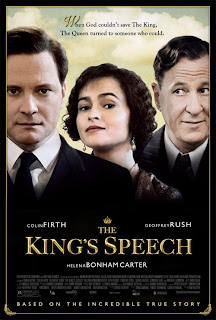
Why 'The King's Speech' Shouldn't Win Best Picture
Reason #1: This film is Oscar Bait. If you are unfamiliar with this term, it is a label put on the types of films that the Academy historically prefers. Most films that get nominated for Best Picture and the other major categories, to be fair, fall under this distinction. But, The King’s Speech falls under a particular brand of Oscar Bait. This particular brand is made up of the films that speak to the close relationship between cinema and theater and the drive to be recognized as a serious medium of art. This includes musicals (Nine), films about World War II, in particular the Holocaust (The Reader), and biopics, especially those about the British Crown (Elizabeth). If it is also a period piece, preferably set in Britain before World War II, you’re golden. The Academy, hoping to appear appreciative of fine art, will gladly push nominations on these types of films rather than the ones that took more risks and strayed away from the film making norm. This has been pointed to as the reason for Nine’s four Oscar nominations and The Reader getting a Best Picture nomination over the widely popular and critically acclaimed The Dark Knight. Not to say these types of films never deserve the recognition, but it is a well documented bias in the Academy’s history.
The King’s Speech manages to hit several of these notes. It is of course a period piece set in 1930’s London and tells the tale of the Duke of York becoming King George VI. Also, the main conflict of the film is the King attempting to overcome a stammer so his people will have faith in him and the country as it enters World War II. This is the type of World War II action that the academy loves: ignoring the dirty, ugly warfare and concentrating on the effects past the battlefield (see: Saving Private Ryan, which undeservedly lost Best Picture to Shakespeare in Love, a period piece). Oh, the Academy also loves films where the main character has to overcome a disability (see: Forrest Gump, which undeservedly won over one of the most influential films in recent history, Pulp Fiction).
I should mention that I don’t believe films like these should not be made. They tell interesting tales that are enjoyable and open overlooked chapters of history to a new audience. But, stacking the deck so heavily in one’s own favor for praise from the Academy is frustrating, especially when films attempt to do this every year. What I would like to see from future films of this particular sort that deal with the Crown are to take more risks in their film making and not to just play to the audience who will give you the award. Challenge your audience.
Reason #2: The ending of the film is curious. For those who haven’t seen the film, King George gives a flawless speech to his nation, impressing his teacher/ friend, his wife, his country, and himself. With the victory under his cap he goes on his balcony to acknowledge his people. The country is ready for World War II! That last part bothers me. The film is meant to end on an uplifting note of personal triumph over seemingly insurmountable odds. As the jovial, celebratory score kicks in and King George confidently stands over his people, all I can think is “How about some perspective here?” One of the most brutal struggles in the history of society is beginning, the Holocaust is occurring on the same continent, and I’m meant to be revelatory over the King of England overcoming a speech impediment? I’m aware, though, that this is where the story has to end and I doubt there was a way to keep what I just mentioned in context and still achieve a feel-good ending. It just leaves me with a poor taste in my mouth as I leave the theater.
Reason #3: The film’s not saying anything new or interesting. This is pretty much all my personal preference, but Best Picture should go to a film with subversive or challenging themes. The King’s Speech is about personal triumph, overcoming the obstacles each of us is presented from the day of our birth, learning to trust others, and, to a certain extent, fulfilling our destiny. These are all classic themes in cinema and are important for people to see and enjoy, but The King’s Speech does not do much to this established genre. One could argue that the film is trying to say something about class systems, mainly that we lose opportunities for greatness when this type of system is strictly observed. The film, though, fails to take this idea to fruition, settling for the need for classes shown by the importance of the King in the universe of the film. Thus, the film fails to challenge its audience and is happy to stay a good personal story of growth, which it does wonderfully. I just would hope for more from what is supposed to be the best film of the year.
Also, this poster is TERRIBLE!-Daniel Perry
Friday, November 19, 2010
Have You Even Seen his Work in ‘Kitty Cat Man’?
I’m going to say something that has come to be a curse among seemingly all fans of cinema: I Love Michael Cera. Based on his recent cinematic draw, it seems that the general viewing public has come to despise young Cera. The generally accepted rationale for this view is that he, “plays the same character,” and “doesn’t branch out.” The reason Cera has been constantly placed in this character is due to his breakout role on Arrested Development. In this role, Cera cemented his ability to play young and awkward, trying to find love where it probably shouldn’t be. His success on the show has led him to be typecast into such roles, but he has played each with their own subtleties. This is exemplified by recent roles in Youth in Revolt and Scott Pilgrim vs. The World where Cera has broadened his range. So, yes, Michael Cera, thus far, has played essentially “one” role, but this shouldn’t be a slight against Cera. For one thing, he is still very young. At just 22 year old is it any wonder that he hasn’t really begun taking more challenging roles? Second, there are far more actors who do one type of character without the audience turning on them. Nic Cage, Sylvester Stallone, and Bill Murray all come to mind, all of which haven’t seen a slip in their returns due to this. So, stop acting like you don’t like Cera because he does the same roles. Just admit to yourself that you hate him because he plays hipsters.
-Dan Perry
History and Film
Thursday, November 11, 2010
He’s More than Just Tairy Greene
He’s so much more. Zach Galifinakis should be considered for more serious roles. With his work in Visioneers, Into the Wild, and, most recently, It’s Kind of a Funny Story, Galifinakis has proven he is capable of holding his own in more dramatic roles. I’m not saying that he should abandon his comedic endeavors. I relish each and every single one of Galifinakis’s comedic ventures, whether it be in film, television, or online. I’m just saying that Zach Galifinakis has the potential to be a fantastic actor, not just comedian.
-Dan PerryMonday, February 18, 2008
Juno
Teenage pregnancy may seem like a strange subject for an independent comedy, but Juno succeeds because it tells the story of an unconventional teenage girl. Juno MacGuff (Ellen Page) is an intelligent, sarcastic sixteen-year-old girl who unexpectedly becomes pregnant. Juno initially considers an abortion, but then decides against it. With the help of her loyal friend Leah (Olivia Thirlby), Juno decides to go through with the pregnancy and give the baby up for adoption to Mark and Vanessa Loring (Jason Bateman and Jennifer Garner), a young couple desperately seeking a child. Bateman (Arrested Development) and Garner (Alias; Daredevil) skillfully convey the growing tensions between the Lorings. The film follows Juno through the ups and downs of her pregnancy, which makes her an outcast at her high school. (“They call me the cautionary whale,” Juno quips.)
Directed by Jason Reitman (Thank You for Smoking) and written by first-time scriptwriter Diablo Cody, Juno defies typical Hollywood conventions. Unlike other movies dealing with the same topic, Juno does not romanticize teen pregnancy or make it seem hopelessly catastrophic. The script is full of witty dialogue, and the unique characters are brought to life through the actors’ strong performances. Through the role of Juno, Ellen Page (X-Men) showcases her remarkable acting talents. She captures the full range of Juno’s emotions, from her snarky wit to her insecurities. Michael Cera (Superbad) is likably awkward as Paulie Bleeker, Juno’s sometime boyfriend and the father of her baby. J. K. Simmons (Oz; Spider-man) and Allison Janney (The West Wing) play Juno’s supportive dad and stepmom. The film uses songs from artists including The Kinks, Cat Power, and Belle & Sebastian, which perfectly complement specific scenes. Juno is a truly original, entertaining movie that manages to balance wry humor and poignancy. It has been nominated for multiple awards, including three Golden Globes, and Academy Awards in four categories: best director, best picture, best leading actress, and best original screenplay.
Thursday, November 8, 2007
Across the Universe
Strawberries. War. Lesbians. Bono. Frat boys. Love. The Beatles! “Across the Universe” is so much at once. It is a beautiful movie- one of those rare films you can just sink into, letting go of all of the rules and expectations in your head. Just sit back, smile, and be entertained.
There is a pretty coherent and well-established storyline between all of the song sequences- in my opinion, a little too well-established for a movie that is clearly more about its visual artistry than its relatively unoriginal backstory. However, I did LOVE how the songs were seamlessly and appropriately woven into the plot. They were part of the telling of the story. (My favorite sequences were “Strawberry Fields Forever” and “With a Little Help From my Friends.”)
The casting is perfect: I immediately fell in love with Jim Sturgess, who plays a shaggy haired Brit with deep, dark brown eyes that speak for themselves....Evan Rachel Wood compliments him well as his love interest, a blonde All-American girl who becomes an anti-war crusader. Joe Anderson rounds out the principle three as the carefree and confused college dropout- at a time when those two words mean one thing: it’s off to Vietnam for you.
The actors sing all of the songs in the movie; and yes, Bono has a cameo in which he sings “I am the Walrus!”
Director Julie Taymor is at her best in “Across the Universe.” The choreography, movement, scenery, color, sound, and overall flow of each scene is brilliant. I burst out laughing more than once, as humorous surprises are plentiful. Football players tackle, flip over each other, and…cartwheel(?) in slow motion as a cheerleader walks straight through the commotion, singing softly. On a crowded New York City street, everyone wears suits and marches in formations, except for one newcomer from Chicago- the song is “Come Together.” I could go on, but I have already given too much away!
The movie is not without its serious moments- after all, issues such as war and the civil rights movement are highlighted. I was most moved by the “Let it Be” sequence, which takes place in the midst of the Chicago race riots. The “Strawberry Fields” sequence would have been more resonant if the Vietnam scenes had been more developed. The shots in New York City were real enough; the Vietnam scenes should have been shot outside, too. Realism would have provided an even greater contrast between the bloody violence of the war and the obviously fake dripping, squirting strawberries.
The movie is too long- but at the end I immediately overlooked this flaw because on the whole, the experience was fantastic! This movie is sure to become a cult classic. Across the Universe...is gonna change your world...
Wednesday, November 7, 2007
Classic Comedy Films
All my life, I’ve been a complete movie nerd, from elementary school (Disney, anyone?) to middle school (enduring many films about people giggling at sleepovers) to high school (aha! My introduction to the classics!). College is different from all of this, though, because it is so specific. Even in my major, history, I have to choose whether I want to specialize in world, European, or American history. Why can’t I just focus on Events of the Upper Midwest Which Occurred Between February and March of 1948 and make my job a whole lot easier?
So as I entered college as a freshman, I contemplated what particular kind of movie fanatic to become. Should I don a black turtleneck, drink bitter coffee, and discuss minor films of the New Wave movement, or should I keep a notebook full of loose-leaf paper and direct short movies on the absurdities of college life that attain a cult status on campus?
As the weeks progressed, however, I discovered that, much like in high school, college students like a lot of different movies for a lot of different reasons, so there’s really no one way to be a movie lover. I think everyone can agree that laughter is one of the reasons we watch movies (and a funny movie does sound good around finals!), so I decided, as my first project as a college film buff, to compile a list of five very humorous movies. Lest you think that “good movies” are synonymous with “new movies,” I focused on films made before the year 1990 for this list. So rent these movies, laugh, and enjoy!
Duck Soup (1933). When it comes to old comedians, the Marx Brothers were definitely ahead of their time. It is no wonder that this film hardly made a box-office dent when it was first released but zoomed to popularity in the intellectual 1960’s. Duck Soup, a zany, anarchic film that doubles as an effective satire on politics and war, brims with witty dialogue and puns that come charging at you with rapid speed. Watch it and note how this early form of smart humor influenced comedy routines from Monty Python to Mystery Science Theatre 3000.
Singin’ in the Rain (1952). Of course, Singin’ in the Rain is one of the most beloved musicals of all time. But what differentiates it from other musicals is its ample use of humor, ranging from slapstick (Donald O’Connor’s astonishing “Make ‘Em Laugh” number) to sharp satire on the Hollywood film industry and the reality behind the personas of movie stars (watch for Jean Hagen’s Oscar-nominated performance as a vapid, irritating actress).If anything, the famous twirling-around-a-lamppost dance will make you smile.
Some Like It Hot (1959). Considering the date in which it was made, Billy Wilder’s famed comedy about two men who must disguise themselves as women after witnessing a crime provided a unique (and controversial) alternative to standard comedic fare. The strength of this movie derives not only from great performances by Jack Lemmon and Tony Curtis, but from the fact that it makes you laugh about everyday situations within the absurd situation it presents. This film also proves that the iconic Marilyn Monroe was a talented comedienne.
Annie Hall (1977). Most romantic comedies are not even remotely funny and ask audiences to believe that two beautiful, impossibly attractive people with high-powered professions in New York City would be single. Hand the genre over to a director like Woody Allen, though, and the film becomes a quirky, witty delight laden with references to pop culture and clever repartee to boot. Moreover, what makes this movie so endearing is that the characters are funny, flawed, and individualistic people we can recognize and identify with.
This Is Spinal Tap (1984). If you were to look up the word “parody” in the dictionary, This Is Spinal Tap would appear (not really, but it should). This spoof of heavy metal bands (Spandex pants-check. Bad hairstyles-check.) and the music industry, shot in documentary style, is so clever and realistic that one could be forgiven for mistaking Spinal Tap for a real 1980’s rock band. It offers a plethora of quotes (how many times have you heard the phrase “up to eleven?”), inside references to actual bands, and you grow to love the dim but sweet Spinal Tap.