Tuesday, February 22, 2011

Why 'The King's Speech' Shouldn't Win Best Picture

It will though. Of quick note, this film is great. It is an all around well made piece of cinema with crisp editing, fantastic performances from the three main leads (Colin Firth, Helena Bonham Carter, and Geoffrey Rush) as well as from the supporting roles, the cinematography is note worthy as is every other technical aspect of the film. It is, without question, well deserving of all of its 12 Oscar nominations. But, with all this in mind, I don’t believe it deserves the title of Best Picture of 2010. Please keep in mind, here there be spoilers.

Reason #1: This film is Oscar Bait. If you are unfamiliar with this term, it is a label put on the types of films that the Academy historically prefers. Most films that get nominated for Best Picture and the other major categories, to be fair, fall under this distinction. But, The King’s Speech falls under a particular brand of Oscar Bait. This particular brand is made up of the films that speak to the close relationship between cinema and theater and the drive to be recognized as a serious medium of art. This includes musicals (Nine), films about World War II, in particular the Holocaust (The Reader), and biopics, especially those about the British Crown (Elizabeth). If it is also a period piece, preferably set in Britain before World War II, you’re golden. The Academy, hoping to appear appreciative of fine art, will gladly push nominations on these types of films rather than the ones that took more risks and strayed away from the film making norm. This has been pointed to as the reason for Nine’s four Oscar nominations and The Reader getting a Best Picture nomination over the widely popular and critically acclaimed The Dark Knight. Not to say these types of films never deserve the recognition, but it is a well documented bias in the Academy’s history.

The King’s Speech manages to hit several of these notes. It is of course a period piece set in 1930’s London and tells the tale of the Duke of York becoming King George VI. Also, the main conflict of the film is the King attempting to overcome a stammer so his people will have faith in him and the country as it enters World War II. This is the type of World War II action that the academy loves: ignoring the dirty, ugly warfare and concentrating on the effects past the battlefield (see: Saving Private Ryan, which undeservedly lost Best Picture to Shakespeare in Love, a period piece). Oh, the Academy also loves films where the main character has to overcome a disability (see: Forrest Gump, which undeservedly won over one of the most influential films in recent history, Pulp Fiction).

I should mention that I don’t believe films like these should not be made. They tell interesting tales that are enjoyable and open overlooked chapters of history to a new audience. But, stacking the deck so heavily in one’s own favor for praise from the Academy is frustrating, especially when films attempt to do this every year. What I would like to see from future films of this particular sort that deal with the Crown are to take more risks in their film making and not to just play to the audience who will give you the award. Challenge your audience.
Reason #2: The ending of the film is curious. For those who haven’t seen the film, King George gives a flawless speech to his nation, impressing his teacher/ friend, his wife, his country, and himself. With the victory under his cap he goes on his balcony to acknowledge his people. The country is ready for World War II! That last part bothers me. The film is meant to end on an uplifting note of personal triumph over seemingly insurmountable odds. As the jovial, celebratory score kicks in and King George confidently stands over his people, all I can think is “How about some perspective here?” One of the most brutal struggles in the history of society is beginning, the Holocaust is occurring on the same continent, and I’m meant to be revelatory over the King of England overcoming a speech impediment? I’m aware, though, that this is where the story has to end and I doubt there was a way to keep what I just mentioned in context and still achieve a feel-good ending. It just leaves me with a poor taste in my mouth as I leave the theater.

Reason #3: The film’s not saying anything new or interesting. This is pretty much all my personal preference, but Best Picture should go to a film with subversive or challenging themes. The King’s Speech is about personal triumph, overcoming the obstacles each of us is presented from the day of our birth, learning to trust others, and, to a certain extent, fulfilling our destiny. These are all classic themes in cinema and are important for people to see and enjoy, but The King’s Speech does not do much to this established genre. One could argue that the film is trying to say something about class systems, mainly that we lose opportunities for greatness when this type of system is strictly observed. The film, though, fails to take this idea to fruition, settling for the need for classes shown by the importance of the King in the universe of the film. Thus, the film fails to challenge its audience and is happy to stay a good personal story of growth, which it does wonderfully. I just would hope for more from what is supposed to be the best film of the year.
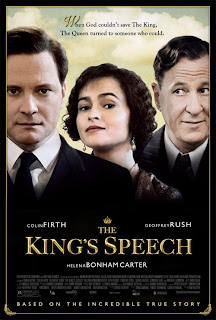
Also, this poster is TERRIBLE!

-Daniel Perry

Monday, February 7, 2011

The Civil Wars


If you haven’t heard of The Civil Wars yet, consider this your tip-off. You’re welcome.

This dynamic duo released their first full length album, Barton Hollow, a week ago and already it’s jumped to number one on iTunes list of hot buys. Rightfully so, I’d say. Sure, the couple got an auspicious vault into the public’s eye when their single “Poison & Wine” was played during an episode of Grey’s Anatomy; Taylor Swift’s benediction didn’t hurt either. But their hauntingly seductive tones and simple compositions have kept the river of success flowing.

While the music of The Civil Wars (Joy Williams and John Paul White) carries components of the neo-folk trend our hipster personas love, there is also a much deeper, raw, sensuous feel to their songs. Tracks like “Barton Hollow” draw images of the secrets in the nostalgic, dirty South (Bontemps anyone?) while “20 Years” bewitches and burrows into the heart of regret. And without fail Williams’ enchanting elegance mixes with White’s rough-hewn (yet somehow silky) depth to create duets that flow naturally, full of emotion and skill.

Look, you don’t have to take my word for it. I’ll even put the links here for you:

Poison & Wine: http://www.youtube.com/watch?v=WfzRlcnq_c0

Barton Hollow: http://www.youtube.com/watch?v=JrOUwbsy12E

Dance Me To The End of Love: http://www.youtube.com/watch?v=bgFh1rEr5dM&feature=related

(The last is a cover of Leonard Cohen’s song. Prepare to have music move you like you wouldn’t believe.)


-Casey Kapalko
Music Editor

Thursday, February 3, 2011

Facebook Status Categories

By Erin Horan
The “Dear__, Sincerely, ___”
Dear Alarm Clock, Please feel free to take a vacation day tomorrow.
Sincerely, Lazy Ass.
The Sympathy Plea
Soooo sick today, can barely move ugh!
The “I Have Friends!”
Evelyn Brown and Jessica Smith are the funniest people in the world!!
The Shameless Plug
My band’s playing at McFarrell’s tonight, come check us out!
The Sports Update No One Needs
THE STEELERS ARE IN THE SUPER BOWL WOOT WOOT
The Weather Update No One Needs
It’s snowing!
The I Feel Guily for (staying up so late watching YouTube, drinking my body weight in alcohol, eating that entire pizza) so I’m Getting It Off My Chest
Four shots of vodka + five beers in two hours = bad idea
The I Need Plans Tonight!
Anyone going out tonight?
The I Have Plans Tonight!
Going out in Boston tonight with my besties!
The I Had So Much Fun Last Night!
Had a blast in Boston last night with my besties!
The This is How Much I Hate Homework/ Grad School Apps/ Work!
Why, why, why do I always leave writing essays to the last minute…
The Happy Holiday!
Happy President’s Day!
The Status of the Week
It’s Sister Week! If you have a sister who you love and will love forever, copy and post this status!! Or it’s like you’re saying you really don’t love your sister!!
The Optimum Way to Contact Me in the Near Future
Lost my phone so facebook me! or
Will be away from my computer this weekend so text me!
The Obscure Song Lyrics
“And the seasons, they go round and round, and the painted ponies go up and down…”
Annnnd of course:
The Intimate Details of My Daily Life
Just ate lunch (turkey sandwich with mayo and chips) now time to clip my toenails! They’re disgusting!

Friday, November 19, 2010

Have You Even Seen his Work in ‘Kitty Cat Man’?

I’m going to say something that has come to be a curse among seemingly all fans of cinema: I Love Michael Cera. Based on his recent cinematic draw, it seems that the general viewing public has come to despise young Cera. The generally accepted rationale for this view is that he, “plays the same character,” and “doesn’t branch out.” The reason Cera has been constantly placed in this character is due to his breakout role on Arrested Development. In this role, Cera cemented his ability to play young and awkward, trying to find love where it probably shouldn’t be. His success on the show has led him to be typecast into such roles, but he has played each with their own subtleties. This is exemplified by recent roles in Youth in Revolt and Scott Pilgrim vs. The World where Cera has broadened his range. So, yes, Michael Cera, thus far, has played essentially “one” role, but this shouldn’t be a slight against Cera. For one thing, he is still very young. At just 22 year old is it any wonder that he hasn’t really begun taking more challenging roles? Second, there are far more actors who do one type of character without the audience turning on them. Nic Cage, Sylvester Stallone, and Bill Murray all come to mind, all of which haven’t seen a slip in their returns due to this. So, stop acting like you don’t like Cera because he does the same roles. Just admit to yourself that you hate him because he plays hipsters.

-Dan Perry

History and Film

History and Film: A Lovely Marriage
By Ally Di Censo
“Many characters in historical films seem somehow aware that they are living in the past.”—Roger Ebert, in his praiseworthy review of Marie Antoinette, 2006
The above quote by renowned film critic Roger Ebert is, I believe, spot on. As a history major and a film lover, I inevitably encounter people who love to rip apart movies with a historical setting for being “inaccurate.” Sure, I can understand people’s anger towards lazy research errors, like an iPod appearing in a film set in 1985 (although these errors tend to be exaggerated. All movies, even those set in the present day, contain gaffes—why latch on to minor flaws in otherwise good films?). However, what bothers me the most is the implication, espoused by many fellow history lovers, that if historical movies had only followed history down to a T, they would be better films.
Don’t get me wrong: I am passionate and serious about history. I was History Club president in my high school, I hope to become a history teacher after I graduate—you get the gist. However, I am also passionate about film and literature, and I realize that fiction is a completely different medium than a factual history textbook. Often, a level of anachronism is necessary for a movie to attain its artistic vision. And, as Roger Ebert indicated, this level of anachronism frequently helps a historical film achieve the admirable task of making history come alive. People who lived in, say, 1875 didn’t consciously think that they were living in a historical epoch. They were simply living in the present, their present. A film that becomes too concerned with recreating 1875 at the expense of other aspects, such as character development and story, can feel like little more than an animated museum waxworks display. However, a film that works hard to recreate the details of 1875, but also considers innovative ways to make the past relevant—whether it be by putting in a non-diegetic soundtrack of contemporary songs, or by giving as equal attention to the universal themes of its story as to its historical period—is doing something right.
To illustrate my point, I would like to talk about two films from the past year that received some unfair criticism from history buffs. One of them, Inglourious Basterds, is an Oscar-nominated epic; the other, Sherlock Holmes, is a thinking person’s popcorn flick. Inglourious Basterds sent several historians into a tizzy because—spoiler alert—Hitler and the Nazi high command is killed at the end by the titular group of Jewish-American soldiers. However, Inglourious Basterds was never meant to be an accurate depiction of American World War II combat. It is a revenge fantasy, a fable, made clear by its opening narration of “Once upon a time.” Moreover, like many Quentin Tarantino films, Inglourious Basterds is a movie about movies. In this case, it’s his homage to WWII combat B-flicks and Spaghetti Westerns that always carried a sense of over-the-top heroics to them. Similarly, some critics complained that an action hero version of Sherlock Holmes clashed with its Victorian London setting. Instead, Guy Ritchie’s steampunk adventure brought new life into a literary character in danger of becoming nothing more than a stereotype, keeping the detective’s trademark intelligence and wit with renewed coolness. As such, the 2009 Sherlock Holmes feels more in tune with Sir Arthur Conan Doyle’s original creation than some of the character’s previous, stuffier incarnations.
I agree that there are definitely limits to how history should be presented in film. I People should raise an outcry over films that distort the facts and realities of history to serve an agenda, as these often ignore or grossly misrepresent racial and social tragedies throughout history. These would include movies that gloss over the treatment of Native Americans by white settlers in the West, or movies that provide a glorified picture of the antebellum American South. Movies that completely disregard the troubling aspects of the past in favor of presenting a sanitized version of events are not only a historical travesty, but also hurt present and future efforts at social justice. Also, it’s bad when movies impose modern sensibilities over historical attitudes. For example, some historical films show all of their female characters as being as liberated, accepted, and outspoken as women in 2010. They imply that women have always had it easy, which most certainly isn’t true.
However, a culturally sensitive film which strives to make history as relevant and alive as possible should be applauded. Historical accuracy is not the sole determinate of whether a movie is good or not (trust me, there are plenty of other things that can ruin a film before historical accuracy). Good movies, no matter what their setting, should make people think and inspire discussion. And good historical movies should banish the perception of history as some stodgy and outdated topic. While remaining true to the sensibilities and details of their time period, they should make the audience feel as if they are watching characters with the same concerns and emotions recognizable in our peers today: fear, love, humor, cynicism, outrage, bravery, evil, affection. These emotions are timeless. Let’s stop focusing on petty details and make movies timeless as well.